
The 2025 Elgin Needs Assessment
2025 Assessment Set-up

2025 Results
Strategic Plan
(4 Focus Points)
The Assessment Setup
One Collective Elgin is dedicated to gaining a deeper understanding of the community. Our vision is for every person in Elgin to have their voice heard, access the resources they need, and contribute meaningfully to the community. To support this vision, we began by actively listening to community members. The following report highlights what we learned.
From August 2025 to May 2026, 338 conversations with unique individuals were logged, coded, and studied. Below is a simple report of what was discovered in this research about the needs in our community.

Setup:
Every participant was asked three questions:
“Make a list of your top 3-5 biggest problems in your community or in the city of Elgin. Which would you fix first?”
“What resources or skills do you have that you would be willing to contribute to solving any of the problems in our city?”
“Where are you and/or the people in your community finding hope right now?”
Then they were asked if they were willing to share their demographic information.
Limitations:
Our study was conducted by volunteers -- not trained scientists.
The people studied were not random, rather, they were selected by a snowball method. This means interviewers asked people they knew to participate, and then asked participants to recommend the next interviewee.
It is not a randomized sampling, therefore, it cannot be generalized to all of Elgin, and if the study was conducted again, it could not be guaranteed that the same answers would be found.
Our study was coded by three members of the One Collective team. Though every effort was made to read the results without bias, undoubtedly some biases still affect the codes chosen and the way the results are articulated.
Coding:
After each member of the coding team read all of the lines of data, the codes were chosen based on collective decision-making. Then, all of the lines were read by each team member again in order to tabulate the number of times each theme was seen. Any doubts about how to code responses were resolved through team discussions.
Because the questions are open ended, people’s answers are sometimes counted in multiple code categories if they listed multiple problems or multiple resources/skills. What is counted is the number of responses that fit that code.
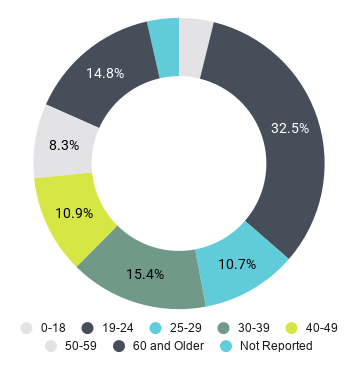
At the end of the interview, we invited participants to share their demographic information if they felt comfortable doing so. Sharing this information was completely voluntary.
| Age of Respondents | Number of Responses |
|---|---|
| 0-18
|
13 |
| 19-24
|
110 |
| 25-29 | 36 |
| 30-39 | 52 |
| 40-49 | 37 |
| 50-59 | 28 |
| 60 and Older | 50 |
| Not Reported | 12 |
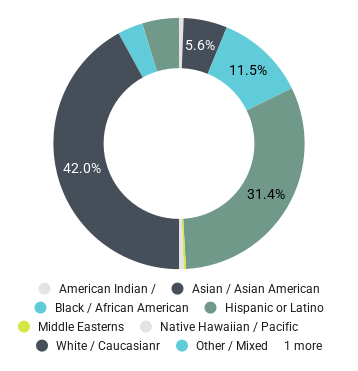
| Race / Ethnicity | Number of Responses |
|---|---|
| American Indian /
|
2 |
| Asian / Asian American | 19 |
| Black / African American | 39 |
| Hispanic or Latino | 106 |
| Middle Easterns | 1 |
| Native Hawaiian / Pacific Islander | 2 |
| White / Caucasianr | 142 |
| Other / Mixed | 11 |
| Not Answered | 16 |

Results
BIGGEST PROBLEMS
Question 1
“Make a list of your top 3-5 biggest problems in your community or in the city of Elgin. Which would you fix first?”
| Biggest Problems | Number of Responses |
|---|---|
| Housing and Homelessness
|
233 |
| Infrastructure | 146 |
| Revitalization | 96 |
| Safety | 94 |
| Community Connection | 86 |
| Community Resources | 57 |
| Education | 37 |
| Youth and Family Resources | 28 |
*Results for Question 2 (n=338)
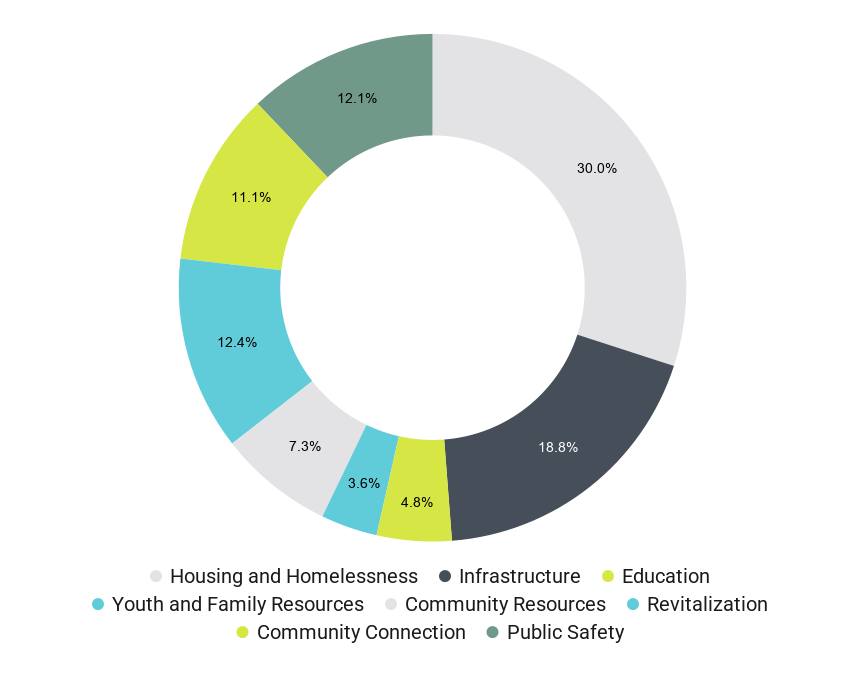
The people who participated in the survey identified a variety of concerns impacting the Elgin community. When asked to identify the three biggest problems facing the city, Housing and Homelessness was the most frequently cited issue, accounting for 30% of responses, followed by Infrastructure at almost 19%, and Revitalization a little over 12%. When asked to prioritize issues to address first, Housing and Homelessness ranked as the top, accounting for almost 40% of responses. Infrastructure remained the second-highest priority, followed by Community Connection. These findings suggest that residents view stable housing as the foundation for addressing many of the city's broader challenges.
Comments related to Housing and Homelessness frequently focused on the rising cost of living, limited affordable housing availability, housing instability, and concerns about homelessness. People expressed a desire for greater access to affordable housing options and additional resources to support individuals and families experiencing housing insecurity. One person shared that “the city is not giving tangible and sustainable solutions for the homeless community,” while another person expressed that “either people are not aware of resources or there are not enough resources for them.” These responses demonstrate both the need for more housing options and greater awareness of, and greater access to existing social service agencies. Housing and Homelessness has continued to remain the community's top concern across multiple needs assessments. In the 2022 Community Needs Assessment, Housing and Homelessness represented almost 60% (2022 Needs Assessment) of people’s responses, making it the most frequently identified issue. Also, in the 2020 Community Needs Assessment, Housing and Homelessness accounted for nearly 50% of responses. The continued focus on Housing and Homelessness in the 2024 Community Needs Assessment highlights that the community members in Elgin view Housing and Homelessness as one of Elgin’s most pressing challenges.
The community’s second-biggest issue was Infrastructure, with concerns about road conditions, traffic congestion, public transportation, pedestrian safety, and the need for improvements to public spaces. Residents of Elgin discussed the importance of maintaining city infrastructure while also expanding accessibility and connectivity throughout the community. One community member expressed concern about the “lack of walkable roads; there are multiple roads without sidewalks, making it dangerous for people to get around,” while another emphasized the need for “more garbage cans, more lighting, and better sidewalks.” These comments suggest that the residents of Elgin view infrastructure improvements as essential not only for safety but also for enhancing the overall community.
Beyond infrastructure improvements, many people expressed the need to strengthen Elgin’s economic vitality and sense of community. Revitalization and Community Connection reflected people’s desire for additional community events, increased collaboration among organizations, support for local businesses, and efforts to create a stronger sense of belonging among residents. Many members of the community shared their concerns about limited job opportunities and unemployment, while others expressed a desire for Elgin to attract more people and that “many businesses on a few of our main roads are unkempt and can impact the perception of Elgin.” These responses show residents’ interest in seeing continued investment in neighborhoods, public spaces, and initiatives that make Elgin a more connected community.
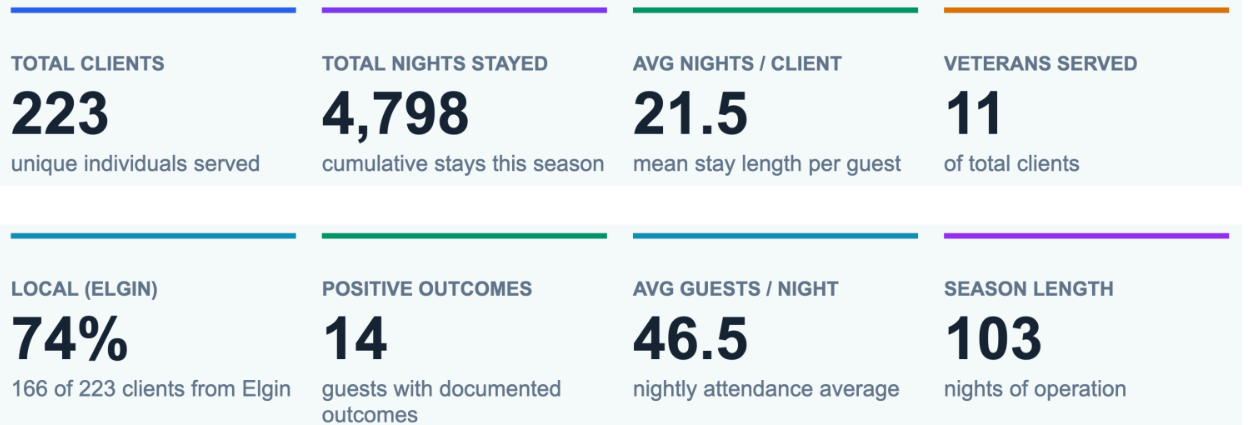
Housing and homelessness continue to be Elgin’s number one concern based on our Needs Assessment. One Collective has listened and responded to this data through our Winter Shelter, which assists the homeless population during the cold Winter months. Below you can see exactly how One Collective Elgin is addressing these concerns based on our data from the 2025-2026 Winter season.
RESOURCES OR SKILLS
Question 2
“What resources or skills do you have that you would be willing to contribute to solving any of the problems in our city?”
| Resources and Skills | Number of Responses |
|---|---|
| Professional/Specialty Skills | 75 |
| Time and Volunteering | 71 | Communication/Advocacy/Outreach | 68 |
| Collaboration and Mobilizing | 34 |
| Mentorship, Training, Development, Education | 22 |
| Tangible Resources | 15 |
*Results for Question 2 (n=338)
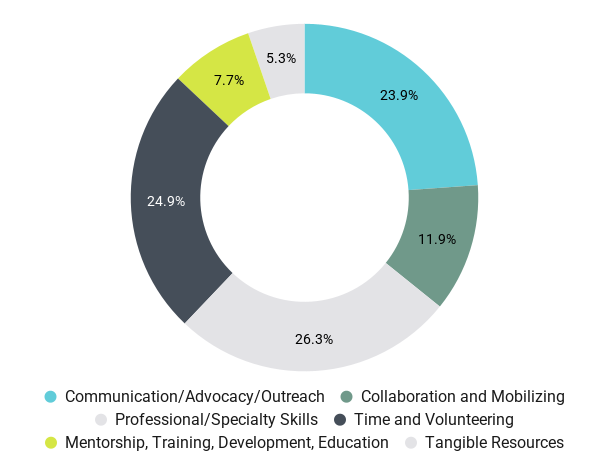
When respondents were asked what resources, skills, or assets they would be willing to contribute toward solving community problems, the results revealed a community rich in human capital and civic engagement. Professional and Speciality Skills (1), Time and Volunteering (2), and Communication, Advocacy, and Outreach accounted for nearly 75% of all responses, suggesting that residents continue to view themselves as active contributors to community solutions. Additional assets included collaboration and mobilization, mentorship, training, development, education, and tangible resources.
These findings are consistent with previous assessments. In 2020, more than half of respondents indicated a willingness to volunteer, while many others reported specialized skills, professional services, networks, language abilities, or donations that could benefit the community. Similarly, the 2022 assessment found that volunteerism represented the largest category of responses, with 242 respondents indicating a willingness to serve and another 99 respondents expressing interest in organizing, networking, or advocacy efforts. Throughout time, the underlying message remains unchanged: Elgin residents possess significant untapped capacity to address community challenges. The prominence of professional skills, volunteer time, communication abilities, and collaboration efforts across all three assessments suggests a sustained willingness among residents to invest in the well-being of their community. These findings reinforce a key conclusion from both the 2020 and 2022 reports, that the challenge facing the community is not a lack of willing people or available talents, but rather the need to better align resources, coordinate efforts, and create opportunities for meaningful engagement.
HOPE
Question 3
“Where are you and/or the people in your community finding hope right now?”
The 2025 Needs Assessment findings indicate that hope in the Elgin community is primarily rooted in relationships, faith, and community connections. Faith/Faith Community emerged as the largest source of hope, accounting for 40.7% of all responses, almost a quarter of all responses mentioned Individual and Family Community. Different answers included that people found Faith in their "church community", in "believing or trusting in God for everything", or even the gospel/bible. This was followed by Individual and Family Community, Local Organizations and Resources, Community Development, Self, None or N/A, and Next Generation/Youth. Together, these findings suggest that residents continue to find hope through both formal and informal support systems, particularly those grounded in relationships, shared values, and collective action.
The 2025 results build upon themes first identified in the 2022 Needs Assessment. In 2022, respondents most frequently identified hope within their communities, relationships, services, and faith. Community groups such as neighborhoods, churches, schools, workplaces, and other social networks were cited as the strongest sources of hope, while family members, friends, and other personal relationships also played an important role. The 2025 findings demonstrate a similar pattern, as people commonly reported to find faith in their church or place of worship. Encouragingly, local organizations, resources, and community development efforts were also identified as meaningful contributors to optimism about the future, suggesting that residents recognize and value collaborative efforts aimed at improving community well-being. While a small percentage of respondents reported finding little or no hope, the overwhelming majority identified positive sources of encouragement, indicating that hope in Elgin continues to be deeply connected to relationships, community engagement, and shared efforts to create positive change.
| Hope | Number of Responses |
|---|---|
| Faith/Faith Community | 150 |
| Individual and Family Community | 88 |
| Local Orgs and Resources | 48 |
| Community Developement | 41 |
| Self | 17 |
| Next Gen/Youth | 10 |
| None | 15 |
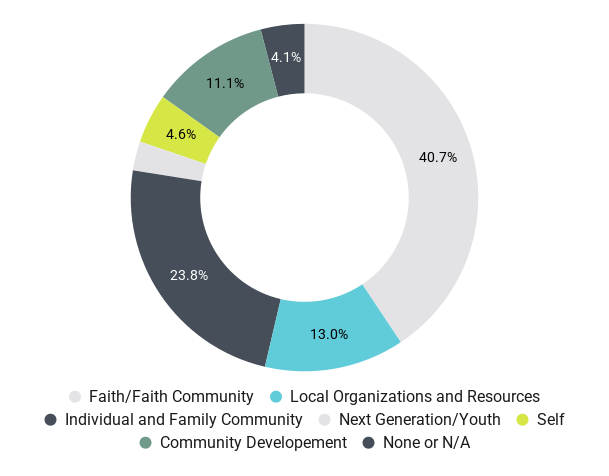
Overall, the findings from the 2025 Needs Assessment tell a consistent story about the Elgin community. While residents continue to identify significant concerns related to housing and homelessness, infrastructure, community connection, and public safety, they also demonstrate a strong willingness to be part of the solution through volunteering, professional expertise, advocacy, collaboration, and mentorship. At the same time, respondents overwhelmingly identified faith and community organizations as their primary sources of hope, highlighting the social and relational strengths that already exist within the community. Together, these findings reinforce One Collective’s asset-based approach to community transformation. Rather than focusing solely on needs, One Collective is using this information to connect residents with opportunities to serve, strengthen partnerships among local organizations, mobilize volunteers, and invest in initiatives that address the community’s most pressing challenges. By leveraging the talents, relationships, and hope already present in Elgin, One Collective can continue building collaborative solutions that promote long-term community well-being and positive change.
For information on how One Collective Elgin intends to solve problems in Elgin, click below to see our strategic plan